


Rotating vs Flat Kids Bookshelf: Which Suits Your Child
Once you have decided a child's bookshelf should be front-facing, showing covers rather than thin spines, the next question is the shape: a rotating bookshelf that spins on a base, or a flat shelf that sits along a wall. Both put covers where a young child can see and choose them, but they suit different rooms and different ages. This guide compares the two on space, capacity and how they grow with a child, so you can pick the one that fits.
In This Article:
- Start With What They Share
- The Rotating Bookshelf: Covers on Every Side
- The Flat Bookshelf: More Books Along a Wall
- Which One Suits Your Room and Age
- Setting Up Whichever You Choose
- Frequently Asked Questions
Start With What They Share
Before the differences, it helps to see what a good rotating and a good flat bookshelf have in common, because that is what makes either one work for a young child. Both display books cover-out, so a child who cannot yet read recognizes a favorite and reaches for it, the way you would browse a shop display rather than a packed row of spines.
Both should be built from solid timber with rounded, sanded edges, and both should let a child reach the books themselves. The front-facing display is the part that matters most, and it is shared; the rotating versus flat question is about the shape that display takes, not whether the child can see the covers.
So this is not a choice between a good shelf and a bad one. It is a choice between two good ways of showing covers, each with its own strengths, and the right pick depends on your room and your child more than on one being better than the other.
The Rotating Bookshelf: Covers on Every Side
A rotating bookshelf stands on a base that spins a full circle, so a child can turn it to face any side and reach the covers there. Because it uses all four sides of a compact footprint, it holds a lot of books on show in the space of a single corner, which is its biggest advantage in a small or shared room.
The OLI Library Revolving Bookcase shows the type at its fullest: solid beechwood, a smooth 360-degree base, four sides of adjustable-depth shelves that hold up to around 350 books, plus a paper scroll on top and rounded built-in pegs. The BINDI Revolving Bookcase is a more compact take on the same idea for a smaller space.

The spinning is not just about capacity; it draws a child in. Turning the bookshelf to see the next side is a small act of choosing, and children who might walk past a static shelf will stop to spin one and end up with a book in hand. The trade-off is footprint depth: a rotating bookshelf needs clear space around it to turn, where a flat shelf sits tight against the wall.
There is a tidiness dividend as well. Because each side of a rotating bookcase is its own small display, a child tends to keep books on the side they are using rather than spreading them across the whole shelf, and the adjustable-depth tiers on a piece like the OLI let you fit both slim board books and taller picture books without them toppling forward. The paper scroll on top turns the same footprint into a drawing station, so the corner does double duty in a room where every square foot is spoken for.
The Flat Bookshelf: More Books Along a Wall
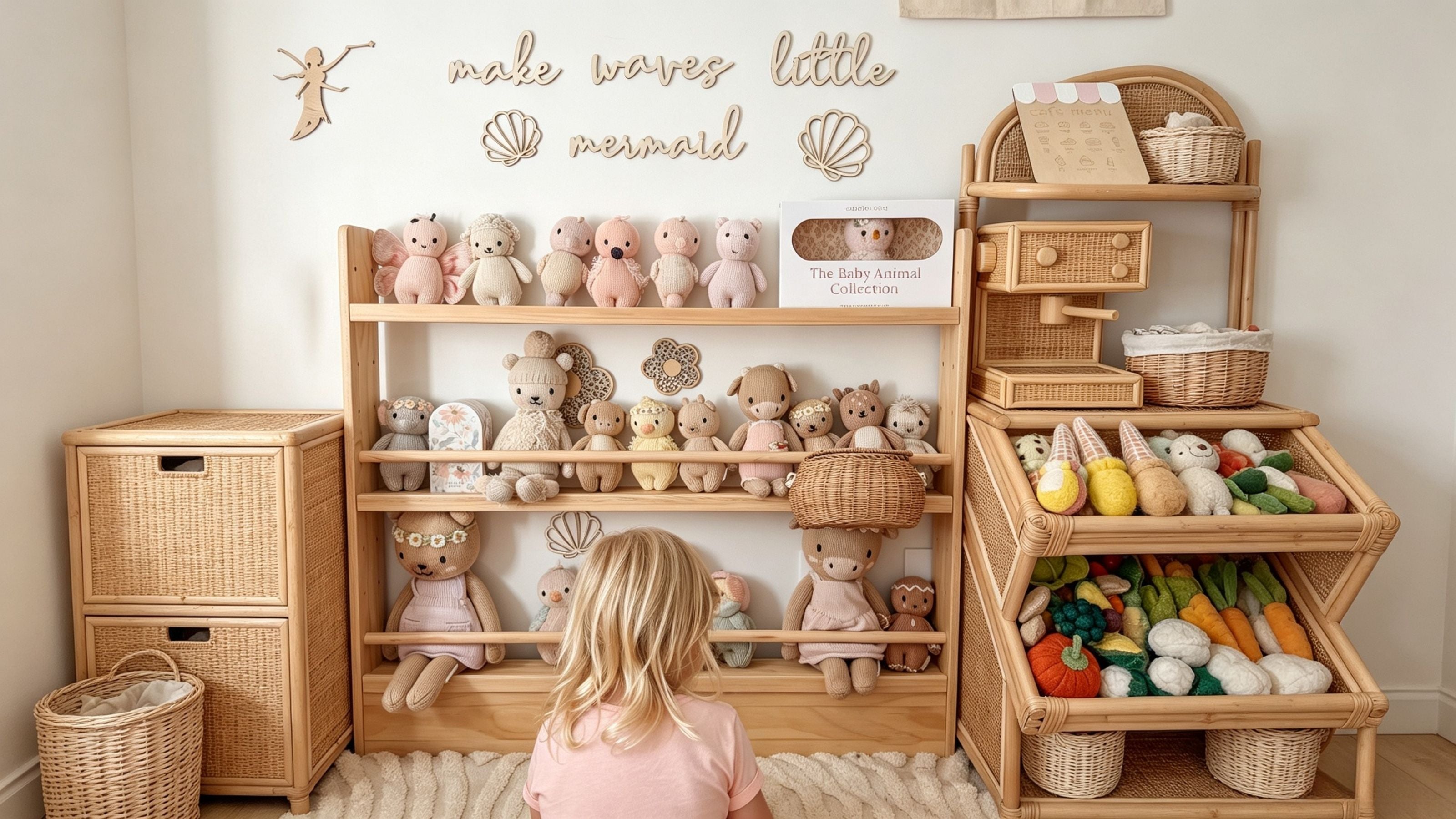
A flat front-facing bookshelf holds its books in tiered pockets that face outward, sitting shallow against a wall. It takes up wall length rather than floor depth, which suits a room where you have a spare stretch of wall but not floor space to spare for something that spins.
The NALA Adjustable Bookshelf is a flat shelf built to move with a child: solid pinewood, front-facing tiers, and shelves that lift out and reposition so you can re-space them for taller books or leave a tier out for extra room. It comes as a three-tier or a five-tier, so you can match it to the wall and the age.
That adjustability is the flat shelf's own version of growing with a child. Where a rotating bookshelf wins on footprint, a flat shelf wins on being shallow, easy to anchor to the wall, and simple to re-space as a child's books change. A flat shelf does need wall anchoring, which is worth planning for when you choose its spot.
The choice between three and five tiers is worth thinking through before you buy. A three-tier shelf keeps every pocket in a toddler's reach, which suits the youngest child, while a five-tier gives an older child more room and lets the top tiers hold the wider collection an adult curates. Because the tiers lift out and reposition, the same shelf can start life with the books low and close, then rise with the child, so a flat shelf that adjusts is less a single fixed layout than a frame you re-space every year or so.

Which One Suits Your Room and Age
The decision usually comes down to space and how much you want on show:
- Tight or shared room: a rotating bookshelf holds the most covers in the smallest floor area, as long as there is room around it to spin.
- Spare wall, shallow space: a flat shelf sits tight against the wall and keeps a walkway clear, which suits a narrow room or a hallway nook.
- Big collection: a four-sided rotating bookcase shows far more at once; a flat shelf shows a curated few and asks you to rotate the selection.
- Changing book sizes: a flat shelf with re-spaceable tiers adapts as picture books give way to taller volumes.
Age plays in gently. A rotating bookshelf's turning appeals strongly to toddlers and preschoolers, while an adjustable flat shelf keeps pace with an older child's growing and changing collection. Many families end up using both over the years, a rotating bookcase in the play space and a flat shelf in the bedroom.
Setting Up Whichever You Choose
Either shelf works best with fewer books on show, not more. A handful of titles a child can actually choose between beats a crammed shelf they cannot take in, and swapping the selection every week or so keeps it fresh without buying anything new.
Put the bookshelf where your child already spends time, near a comfortable spot to sit, so choosing a book and settling down to look at it happens in one move. Keep the books a child chooses from where they can reach them, and anchor a flat shelf to the wall before it goes into use.
Whichever shape you pick, the front-facing display is doing the real work of inviting a child to read on their own. For a wider look at the options, our guide to choosing a kids bookshelf walks through the range in the bookshelf collection.
Frequently Asked Questions
Is a rotating or flat bookshelf better for kids?
Neither is simply better; they suit different rooms. A rotating bookshelf shows the most covers in the smallest floor area and its spinning draws children in, as long as there is space around it to turn. A flat shelf sits shallow against a wall and re-spaces as a child's books change.
How many books does a rotating bookshelf hold?
A four-sided rotating bookcase like the OLI holds up to around 350 books across its sides, far more on show than a flat shelf of the same footprint. A flat shelf shows a smaller, curated selection and asks you to rotate the books over time.
Does a rotating bookshelf take up a lot of space?
It has a compact footprint but needs clear space around it to spin, so allow room to turn. A flat shelf is the opposite: it sits tight and shallow against a wall and keeps a walkway clear, which suits a narrow room or a nook.
Are these bookshelves front-facing?
Yes. Both the rotating and flat shelves display books cover-out, so a child who cannot yet read can recognize a favorite and choose it. The front-facing display is what they share; the rotating versus flat question is about the shape that display takes.
Deciding between the two? See the rotating and flat options together in the kids bookshelf collection and match one to your room.





Leave a comment
This site is protected by hCaptcha and the hCaptcha Privacy Policy and Terms of Service apply.