



When Can a Toddler Use a Kitchen Tower? Age and Safety
A kitchen tower brings a toddler up to counter height so they can wash fruit, stir a bowl and be part of what is happening at the counter, instead of watching from the floor. It is one of the most-used pieces of furniture in a young family's kitchen, but a common first question is when a child is actually old enough to stand in one. This guide covers the right age to start, how to read your own child's readiness, the safety features that matter, and how to use a tower well once it is in the kitchen.
In This Article:
- The Right Age to Start
- Signs Your Child Is Ready
- The Safety Features That Keep a Tower Steady
- Setting the Platform to the Right Height
- Using a Kitchen Tower Well
- Frequently Asked Questions
The Right Age to Start
Most kitchen towers are made for children from around twelve months, and that is a sensible place to start thinking about it. The number on the box, though, is less important than what your child can actually do. The real threshold is standing: a child who can pull themselves up and stand steadily on their own for a stretch of time has the balance a tower asks for.
From about a year, many children are cruising along the furniture and standing without holding on, and that is usually when a tower starts to make sense. Before that, a baby who is not yet standing confidently is better watching from a high chair or a safe spot on the floor, because a tower is built around a child who can hold their own weight on their feet.
At the other end, a tower keeps earning its place for years. Many are rated to around six years, so a child who starts near their first birthday can use the same tower through the preschool years, dropping the platform lower as they get taller. The age on the label is really the start of a long window, not a narrow one.
Signs Your Child Is Ready
Rather than counting months, watch for a few signs your child is ready to stand in a tower:
- They stand steadily on their own, without needing to hold on, for a minute or more at a time.
- They can climb a step or two with a little support, which is how they will get in and out of the tower.
- They can follow a simple instruction, such as stopping when you say so, which matters at a counter with hot pans and sharp tools nearby.
- They want to be up there, reaching for the counter and interested in what you are doing, rather than being placed in a tower they are not keen on.
Not every child hits these at the same age, and that is fine. A cautious toddler might be ready a little later, an early stander a little sooner. The point is to let the child in front of you, not the calendar, tell you when to start.
The Safety Features That Keep a Tower Steady
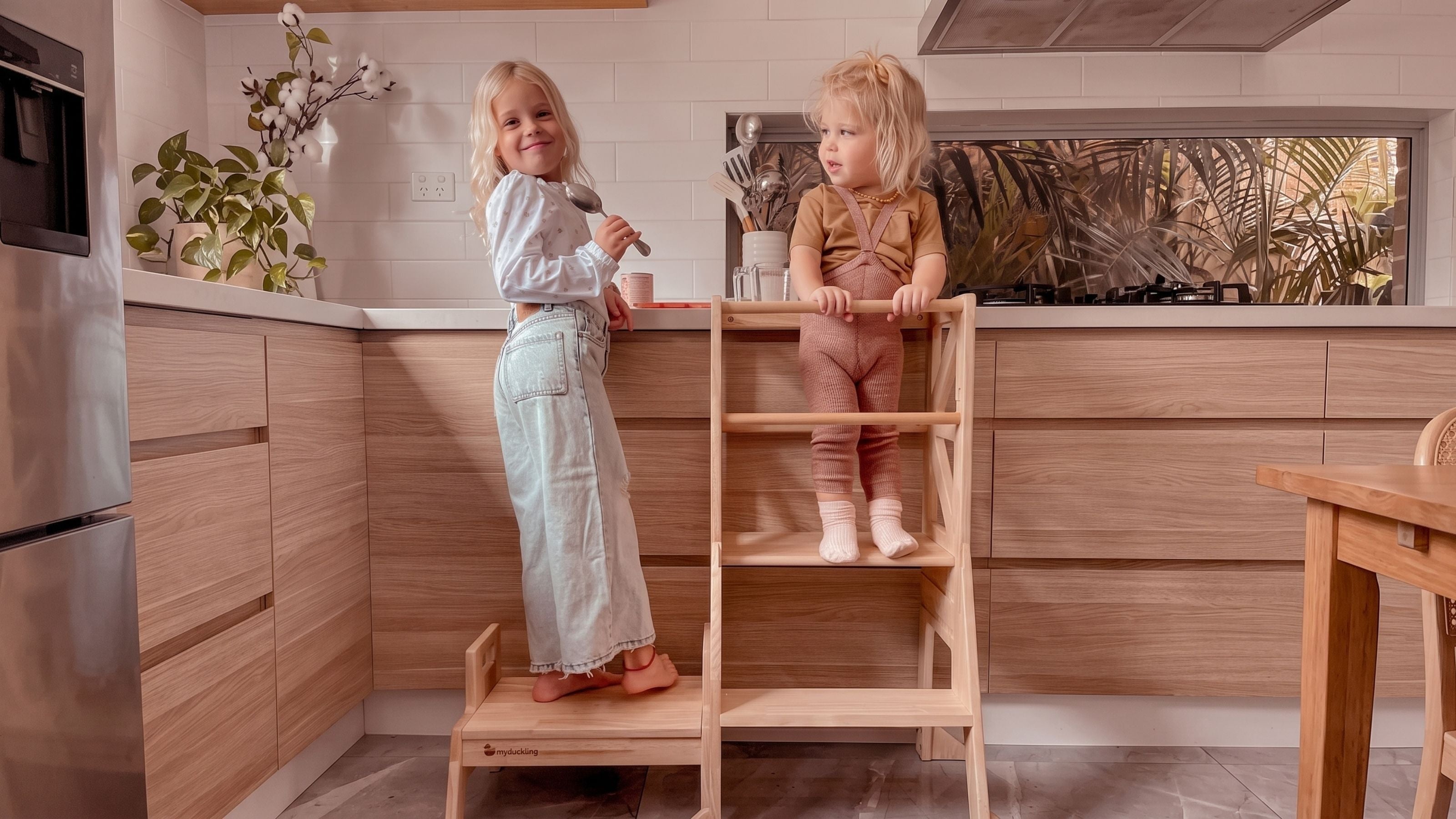
What makes a kitchen tower safe for a young child is the frame around them. A good tower surrounds the standing platform on the sides so a child who wobbles or leans has something holding them in, rather than an open step they can step off. Safety rails at the front and back, and side panels or stabilizers, are what turn a tall stool into something a toddler can use.
The LOLA Kitchen Tower shows what to look for: front and rear safety rails, four removable side stabilizers and a reinforced rear support, with a second front rail you can add for a smaller child under about forty inches tall. A wide, solid rubberwood frame keeps it planted on the floor, and rounded corners matter on a piece a child uses up close.
Weight capacity is worth a glance too, though it is rarely the limit in practice: these towers hold around 220 pounds, far more than any toddler, which tells you the frame is built to be leaned on and climbed. The JALA Kitchen Tower pairs the same rail-and-stabilizer setup with rounded corners and a step a child can climb in and out of on their own.

Setting the Platform to the Right Height
A tower works best when the platform brings your child's chest and arms up to the counter, so they can reach the work surface without stretching or leaning over the rail. Most towers set the platform to two or three heights for exactly this reason, and the highest setting suits the youngest, shortest child.
As a rule, start with the platform at its tallest setting when your child is small, then lower it a step as they get taller so they keep standing at a comfortable height relative to the counter. On a JALA Deluxe Kitchen Tower the platform sets to three heights, from about thirteen to nearly eighteen inches off the floor, which covers a wide span of the toddler and preschool years.
The platform is set by an adult, not the child, which is how it should be. Check the setting every few months as your child grows, and adjust it when they start to look cramped or are reaching up to the counter rather than standing level with it.
Using a Kitchen Tower Well
Even the steadiest tower is only as safe as how it is used, and a few habits keep it that way. Stand the tower on level ground and push it snugly against the counter, so there is no gap for a child to lean into, and keep it away from the stove, the oven door and anything hot.
Keep it to one child at a time, and stay within arm's reach whenever your child is up there; a tower keeps a child at a safe standing height, but it is not a substitute for supervision at a working counter. Move knives, hot pans and cords back from the edge before your child climbs up, and give them a job that suits their age, from washing vegetables to stirring a bowl.
The first few sessions set the tone, so keep them short and simple. A toddler who is new to standing at the counter tires quickly and gets restless, and a five-minute job they finish is worth more than a long one they abandon halfway. Start with something low-stakes, tearing lettuce or pushing a wooden spoon around a bowl, and let them climb down when they are done rather than keeping them up there past their interest.
A small routine around getting in and out helps too. Teach your child to climb up from the step at the back rather than the front, and to face into the tower on the way down, the same way they would come down a ladder. Once they know the pattern they manage it themselves, which is part of what the tower is for, and you spend less time lifting and more time cooking alongside them.

Used this way, a tower turns cooking into something you do together, and the benefits go well beyond the meal. If you want ideas for what to do once your child is up at the counter, our piece on the benefits of cooking with your children has plenty, and our guide to choosing a toddler tower covers picking the right one.
Frequently Asked Questions
What age can a toddler start using a kitchen tower?
Most kitchen towers are made for children from around twelve months, but the real threshold is standing. Once a child can stand steadily on their own and climb a step with a little support, they usually have the balance a tower asks for. Watch the child rather than the calendar.
Is a kitchen tower safe for a one-year-old?
For a one-year-old who stands steadily, yes, provided the tower has safety rails and side support and you stay within arm's reach. Set the platform to its tallest height for a small child, push the tower against the counter on level ground, and keep it to one child at a time.
How high should the tower platform be set?
The platform should bring your child's chest and arms up to the counter so they can reach the surface without stretching over the rail. Start at the tallest setting when your child is small and lower it a step as they get taller. An adult sets the height, not the child.
How long can a child use a kitchen tower?
Many towers are rated to around six years, so a child who starts near their first birthday can use the same one through the preschool years by lowering the platform as they grow. The age on the label is the start of a long window, not a narrow one.
Ready to bring your toddler up to the counter? Browse the kitchen towers and find one with the rails and adjustable height to suit your child.





Leave a comment
This site is protected by hCaptcha and the hCaptcha Privacy Policy and Terms of Service apply.