



What Makes a Bookshelf Montessori?
The word Montessori gets attached to almost any kids bookshelf these days, which makes it hard to know what actually earns the name. The Montessori part is not about a shelf being small or plain. It is about a bookshelf a child can understand and use on their own, one that shows them what is there and invites them to choose for themselves. Here is what that looks like in practice, and what to look for when you buy.
In This Article:
- The Montessori Idea Behind a Child's Bookshelf
- Front-Facing Display, Not Just a Short Shelf
- Being Honest About Reach
- What to Look For in a Montessori Bookshelf
- Setting It Up So a Child Uses It on Their Own
- Frequently Asked Questions
The Montessori Idea Behind a Child's Bookshelf
Montessori rests on the idea that children learn best when they can do things for themselves. Furniture that follows it is made so a child can reach, use and tidy it without an adult stepping in each time. A bookshelf fits this when a child can see the books on offer, take one they want, and put it back in its place afterward.
That independence is the whole point. When a child can choose their own book and return it, reading becomes something they start rather than something handed to them, and packing away becomes part of the activity instead of a chore an adult does later. A bookshelf a child cannot manage on their own quietly hands all of that back to the grown-up.
So the test of a Montessori bookshelf is simple: can a young child, on their own, see what is there, take a book and put it back? Everything else follows from answering yes to that, and most of the features worth paying for are really just ways of making the answer yes.

Front-Facing Display, Not Just a Short Shelf
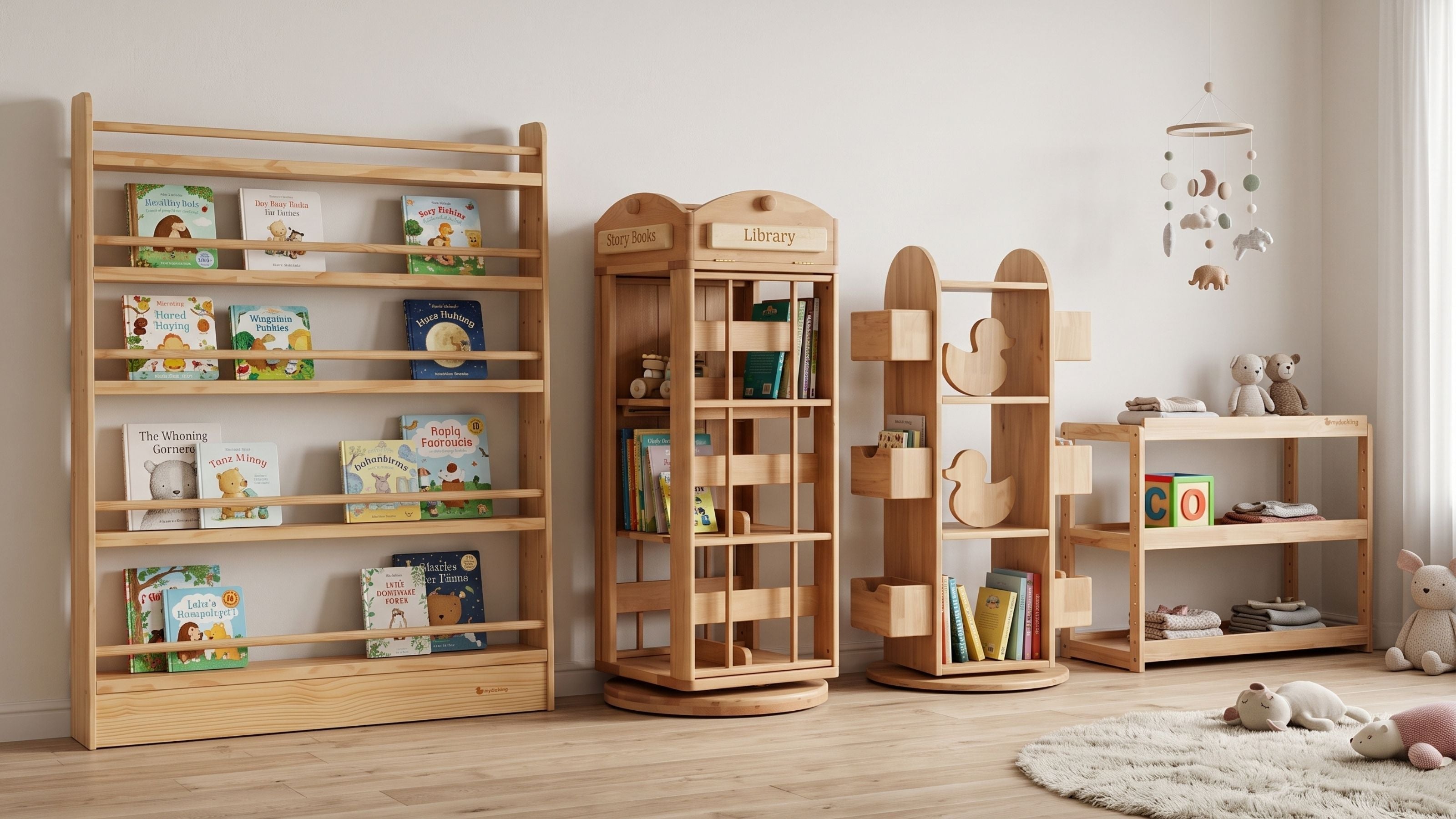
The most common picture of a Montessori bookshelf is a plain flat shelf a toddler stands in front of. Height is part of it, but the piece that really matters is easy to miss: the books face outward, so a child sees the covers rather than a row of thin spines.
This front-facing display is what lets a child who cannot yet read choose a book. They recognize the cover of a favorite and reach for it, the way an adult browses a shop display rather than a packed shelf. A standard spine-out shelf hides all of that, so a young child either gives up or pulls everything down looking for the one they want. A front-facing bookshelf turns the covers into the invitation.
It changes how a child treats books, too. When the covers are on show, a child returns a book cover-out because that is how it came, so the display stays readable instead of collapsing into a jumble within a day. A spine-out shelf gives them nothing to copy, so books go back any way at all and the order is lost. The front-facing layout teaches the tidying without a word being said.
Being Honest About Reach
Montessori furniture is often described as letting a child reach everything, and it is worth being straight about what that means on a bookshelf. On a taller shelf, the upper tiers sit above a toddler, so those become the spot for a grown-up to keep the wider collection, while the tiers a child can reach hold the few books they are choosing from now.
That is not a failing; it is how the shelf is meant to work. A child does not need every book they own in front of them at once. They need a small, reachable selection they can manage on their own, with the rest curated above and rotated down over time. Front-facing display on the reachable tiers is what makes that work, not the height of the whole piece.
An adjustable shelf helps here, because you can set the reachable tiers to your child's height and re-space them as they get taller. A NALA Adjustable Bookshelf lifts its tiers out and repositions them for exactly this reason, so the reachable zone keeps pace with the child.
Being honest about reach also changes how you stock the shelf. Rather than filling every tier a child can touch, leave the lower tiers holding only a handful of titles at a time, so the choice stays manageable and the display never collapses into a heap. The books a child has finished with, or is not ready for, move up to the adult tiers and come back down in rotation. Handled that way, the shelf teaches a child that a small, ordered selection is easier to use than a crammed one, which is the same lesson the front-facing display is quietly making at their eye level.
What to Look For in a Montessori Bookshelf
Beyond the front-facing display, a few practical things separate a bookshelf a child really uses from one that just looks the part:
- Solid timber and a stable stance, whether that is a wall-anchored flat shelf or a weighted rotating base, so it holds firm when a child leans or pulls a book from the edge.
- Rounded, sanded edges, because a child uses this piece up close and unsupervised.
- Reachable tiers for their age, holding a small, changing selection rather than the whole library at once.
- A shape that fits your room, a shallow flat shelf along a wall or a rotating bookcase that shows covers on every side.
A rotating design like the OLI Library Revolving Bookcase carries the front-facing idea onto all four sides of a compact base, while a flat adjustable shelf keeps it shallow against a wall. Both can be Montessori; what makes them so is the cover-out display and a child being able to use them alone.

Setting It Up So a Child Uses It on Their Own
A Montessori bookshelf works best with fewer books on show, not more. A handful of titles a child can actually choose between beats a crammed shelf they cannot take in, and swapping the selection every week or so keeps it fresh without buying anything new. Keep the books a child chooses from on the tiers they can reach, and use any higher tiers for the rest.
Put the bookshelf where your child already spends time, near a comfortable spot to sit, so picking a book and settling down to look at it happens in one move. A reading corner a child sets up and packs away themselves builds the habit far better than a shelf they are lifted up to.
Show them once how to take a book and put it back, then let them run it. The point of the whole design is that, after that first show, they do not need you for it. For help choosing between shapes and sizes, our guide to picking a kids bookshelf walks through the bookshelf collection.
Frequently Asked Questions
What makes a bookshelf Montessori?
A Montessori bookshelf is one a child can use on their own: it shows book covers face-out so a child who cannot yet read can choose for themselves, and it is built so they can take a book and put it back without help. Front-facing display matters more than the shelf simply being short.
Does a Montessori bookshelf have to be low?
No. What matters is that a child can reach a small, changing selection on the lower tiers and use the shelf on their own. Higher tiers can hold the wider collection an adult curates and rotates down. Front-facing display on the reachable tiers is the key, not the height of the whole piece.
Is a front-facing bookshelf better than a spine-out one?
For young children, yes. A front-facing shelf shows covers rather than thin spines, so a child recognizes a favorite and reaches for it. A spine-out shelf hides the books, so a toddler often gives up or pulls the whole row down looking for one.
What age is a Montessori bookshelf for?
A front-facing bookshelf suits a child from around their first year, when they start reaching for books, through the early school years. Keep the books a child chooses from on the tiers they can reach, and use any higher tiers for the wider collection.
Looking for a front-facing design? Browse the kids bookshelf collection and find one your child can use on their own.





Leave a comment
This site is protected by hCaptcha and the hCaptcha Privacy Policy and Terms of Service apply.